Introduction
Air fryer technology has transformed how many people approach cooking at home, offering a faster alternative to traditional ovens for certain applications while requiring significantly less oil than conventional deep frying. The landscape of air fryer options has expanded considerably, ranging from compact countertop models designed for single servings to larger units intended for families or those who prepare meals in batches.
The Chefman 8 Qt TurboFry represents one of the larger entries in the air fryer market. Understanding what distinguishes a large-capacity model, how its specific features function, and whether such a device aligns with your cooking habits requires looking beyond marketing language and examining the practical realities of how these appliances work.
This guide explores the specifications, capabilities, and practical applications of this particular air fryer system, helping you understand whether a unit of this size and feature set makes sense for your kitchen setup and cooking needs.
What Defines This Air Fryer’s Approach
Before diving into specifics, it’s useful to understand what differentiates this model within the broader air fryer category. The 8-quart capacity immediately stands out—most standard air fryers range from 2.6 to 6 quarts. This size difference has cascading implications for everything from cooking times to the physical space required on your countertop.
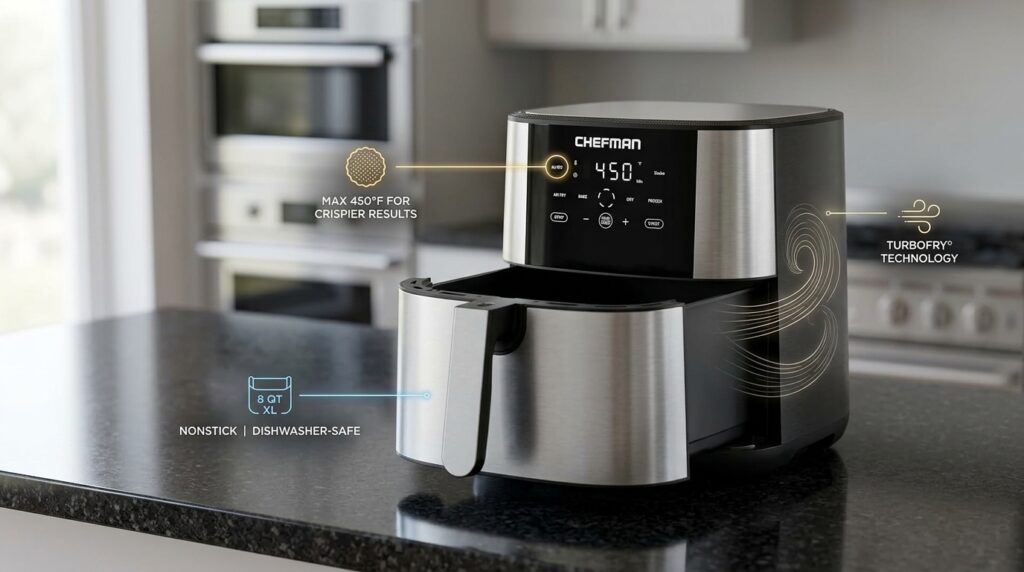
The TurboFry branding appears to reference the heating and air circulation mechanism, which manufacturers use to describe their convection system. Air fryers fundamentally operate by rapidly circulating extremely hot air around food, allowing browning and crisping without traditional deep frying methods.
The 450°F maximum temperature specification warrants attention. Many conventional air fryers max out around 400°F. This additional 50 degrees can influence browning rates and texture outcomes for certain applications, though the practical significance varies depending on what you’re cooking.
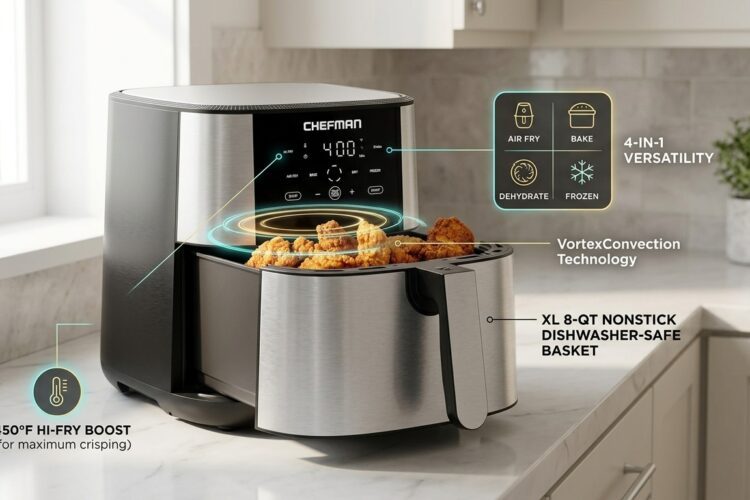
The 4-in-1 functionality—which encompasses air frying, baking, dehydrating, and handling frozen foods—indicates this unit attempts to consolidate multiple cooking functions into one appliance.
Key Features and What They Mean in Practice
Capacity and Cooking Space
An 8-quart basket represents a substantial piece of equipment. To contextualize this: a standard air fryer basket typically holds enough for 2-3 servings, while an 8-quart capacity could theoretically handle family-sized portions or multiple batches worth of food in a single operation.
This capacity has real implications. It means you could potentially prepare chicken for an entire family without splitting the cooking into multiple rounds. You could roast a large batch of vegetables and portion them for the week. You could cook frozen items for several people simultaneously.
However, larger capacity comes with trade-offs. Bigger baskets mean more countertop and storage space requirements. They also mean longer preheat times and potentially longer cooking times, as hot air has more volume to circulate through. The heating efficiency that makes smaller air fryers appealing—quick preheat, rapid cooking—becomes less pronounced at this scale.
The 450°F Maximum Temperature
Temperature capabilities matter for specific cooking outcomes. The difference between 400°F and 450°F might seem marginal, but it influences how quickly browning occurs and can affect texture.
For instance, achieving deeply browned exteriors on chicken skin or getting maximum crispiness on frozen fries happens more readily at higher temperatures. However, this doesn’t mean foods cooked at 400°F won’t achieve satisfactory results—they may simply require slightly longer exposure or careful monitoring.
The practical relevance of this feature depends on your cooking preferences. If you’re frequently seeking deep browning and maximum texture contrast, the extra 50 degrees offers a tool for that goal. If your cooking is more about quick weeknight meals and functional results rather than particular texture optimization, the practical benefit becomes less significant.
Nonstick Basket with Dishwasher-Safe Construction
The nonstick coating serves a practical purpose—it reduces food sticking and simplifies cleanup. Over time, nonstick coatings can wear, particularly with frequent washing and use of metal utensils. The dishwasher-safe specification means you can clean it without hand-washing, which matters for convenience during busy periods.
That said, the longevity of nonstick coatings varies. Using wooden or silicone utensils to avoid scratching, hand-washing to reduce thermal shock, and avoiding abrasive scrubbing extends the lifespan of the coating. These practices aren’t required—they’re optional steps for those prioritizing maximum durability.
Stainless Steel Exterior
The stainless steel housing affects appearance and maintenance more than performance. Stainless steel resists fingerprints and corrosion better than plastic-heavy designs, and it contributes to a more durable feel. It does require occasional polishing to maintain shine and can show water spots if you live in an area with hard water.
The Dehydration Function
Included dehydration capability expands potential uses beyond frying. This function operates at lower temperatures than the frying modes, allowing you to dry foods like herbs, fruit slices, or vegetable chips.
The practical value here depends on whether you actually use dehydration functions. Many appliances marketed with multiple capabilities feature functions that rarely see use. If you’re already interested in making jerky, dried fruit, or other dehydrated foods, this built-in function eliminates the need for a separate purchase. If dehydration isn’t something you currently do or anticipate doing, it’s a feature that exists but doesn’t affect your daily cooking.
Handling Frozen Foods
Air fryers generally handle frozen foods well—often better than conventional ovens in terms of cooking speed. This model’s specific mention of frozen food capability likely indicates its capacity to handle items directly from the freezer without extensive thawing, though package instructions would always guide specific protocols.
Understanding How Large-Capacity Air Fryers Fit Into Home Cooking
The shift from a standard 4-5 quart air fryer to an 8-quart model represents a philosophical change about how you’d use the appliance. It moves from being primarily a quick weeknight meal tool toward something positioned more as a batch-cooking or large-gathering solution.
Consider realistic cooking scenarios:
Family Dinners: If you’re regularly cooking for 6+ people, a larger capacity reduces the need to split cooking into multiple rounds. You could prepare a full batch of chicken wings, fish fillets, or roasted vegetables in one cycle rather than two or three.
Meal Preparation: People who dedicate time to preparing multiple meals simultaneously—perhaps on a Sunday for the upcoming week—might find an 8-quart capacity appealing. You could potentially prepare several different items or large quantities of the same item without repeating cycles.
Entertaining: For gatherings where you’re preparing appetizers or sides, larger capacity reduces the need to carefully schedule the cooking to ensure everything finishes around the same time.
Small Batch Cooking: Conversely, if you’re regularly cooking for one or two people, an 8-quart capacity means mostly empty space. You’d still be using only a fraction of available room, which somewhat defeats the purpose of buying the larger size.
Comparing Air Fryer Types and Categories
Understanding where this model sits within the broader air fryer landscape provides useful context:
Compact Air Fryers (2-3 quarts) excel at single servings and quick meals. They heat rapidly, take minimal counter space, and cost less. They’re ideal if you live alone, cook for two people most days, or want something portable.
Mid-Range Models (4-6 quarts) represent the most common category. They balance reasonable capacity with manageable size and heating efficiency. They work well for families of 4-5, offer good counter presence without dominance, and retain much of the speed advantage air fryers provide.
Large-Capacity Units (7+ quarts) prioritize volume over compactness. They make sense when cooking for larger groups regularly or when batch cooking is a major part of your routine.
Within the large-capacity category, options differ based on heating technology, available heat settings, additional functions, and build quality. Some models use dual heating elements for more even cooking. Others offer digital controls versus analog dials. Some include preset programs, while others require manual temperature and time adjustments.
The stainless steel construction and specific temperature range of the Chefman model position it at a particular point on the quality and capability spectrum within large-capacity options. It’s more robust than budget models but potentially less feature-rich than premium alternatives that might include app connectivity or advanced programming.
Practical Applications and Cooking Scenarios
An 8-quart air fryer opens possibilities that smaller models can’t accommodate as efficiently:
Preparing Proteins for Large Groups: A whole batch of chicken breasts, turkey cutlets, or fish fillets can cook simultaneously. For those who entertain regularly or have large families, this eliminates the orchestration required with smaller units.
Vegetable Roasting: Root vegetables like potatoes, carrots, and brussels sprouts can be prepared in large quantities for multiple meals or side dishes.
Frozen Foods at Scale: French fries, mozzarella sticks, spring rolls, or other frozen items can be cooked in quantity without the space constraints of traditional ovens or the multiple batches required with compact air fryers.
Dehydrating Bulk Items: If you’re processing several cups of herbs, making fruit chips, or preparing jerky, the larger chamber reduces drying time or allows simultaneous drying of multiple items.
Batch Baking: Some recipes adapt to air fryer baking—small cakes, cookies, or pastries could potentially be prepared in larger quantities than compact models allow.
Experimental Cooking: The temperature range and size provide room to explore air frying applications you might not attempt in a smaller unit.
That said, the applicability of these scenarios depends on your actual cooking patterns. If you rarely cook for more than 3-4 people and don’t engage in batch cooking, most of these advantages don’t manifest in your daily experience.
Who Might Find This Model Suitable
Large Households: Families of six or more where a single air fryer meal would feed everyone simultaneously rather than requiring sequential cooking.
Frequent Entertainers: Those who regularly host dinners, parties, or gatherings where having large quantities of prepared food ready matters.
Meal Prep Enthusiasts: People who dedicate time to preparing multiple meals at once for the week ahead and view large-capacity cooking as a core part of their routine.
Commercial or Semi-Commercial Use: While primarily a home appliance, larger capacity appeals to those operating small catering businesses or food services.
Batch-Focused Cooks: Individuals who approach cooking with an emphasis on preparing multiple portions or multiple dishes simultaneously.
Those Seeking Multi-Function Appliances: If you’re interested in air frying, baking, and dehydrating and view having these capabilities in a single unit as valuable, the 4-in-1 aspect becomes more relevant.
Important Considerations Before Committing to This Size
Space Requirements
An 8-quart air fryer occupies significant counter real estate. Dimensions typically range around 17 inches wide by 15 inches deep by 13 inches tall, though exact specs vary. This isn’t something that fits in a corner of a small kitchen—it’s a substantial presence that requires dedicated space.
If counter space is limited, you’d need to consider whether storage space is available and whether you’d realistically use the appliance enough to justify semi-permanent placement or frequent moving.
Heating Efficiency
Larger units require more time to preheat and circulate hot air through a bigger volume. If you value the speed advantage that air fryers provide compared to traditional ovens, the time savings diminish somewhat with this size. Preheat times might reach 10-15 minutes rather than 3-5 minutes with compact models.
Cooking times also extend, as the appliance works to maintain temperature while cooking larger quantities of food.
Storage
If your kitchen lacks a dedicated appliance storage area, you need to ensure you can store this unit somewhere accessible—pulling an 8-quart air fryer from a high cabinet or deep pantry shelf becomes impractical.
Actual Usage Patterns
An honest assessment of how often you cook for larger groups or engage in batch cooking matters significantly. If you typically prepare meals for 2-3 people most nights, buying an 8-quart model means operating well below capacity most of the time. The appliance would still work fine; you’d simply be using less available space, which somewhat undermines the value proposition of buying this particular size.
Learning Curve
Larger capacity sometimes requires adjusting cooking times and potentially turning or rearranging food more carefully to ensure even cooking. The increased volume of hot air circulating requires slightly different mental models compared to smaller units.
Maintenance Considerations
Larger baskets mean more material to clean, even with dishwasher-safe construction. The external surface also requires occasional wiping. These aren’t significant issues, but they represent slightly more maintenance than compact units.
Comparing Air Fryer Approaches: What Sets Different Models Apart
Within the large-capacity category, several factors differentiate available options:
Heating Technology: Some models use single heating elements, while others employ dual elements or advanced circulation systems. Single-element units are simpler but may produce less even heating. Dual elements provide more consistent temperature distribution, particularly important with larger volumes of food.
Temperature Range: Models vary in minimum and maximum temperatures. Higher maximum temperatures (like this model’s 450°F) enable certain browning effects. Lower minimum temperatures (some reach as low as 150°F) expand dehydration possibilities.
Control Interface: Digital touchscreen controls offer preset programs and precise adjustments. Analog dials provide simplicity and durability. Hybrid approaches combine elements of each. Your preference here is personal—some people prefer digital precision, others value mechanical simplicity.
Additional Functions: Beyond the 4-in-1 offered here, some models include rotisserie capabilities, specialized racks for multiple layers, or other features. Whether these additions appeal depends on your cooking goals.
Build Quality: Stainless steel construction signals different durability expectations than plastic-heavy designs. Interior coating quality affects longevity and food release.
Warranty and Support: Manufacturer warranty lengths and quality of customer support vary between brands.
This model falls into a mid-to-upper range within large-capacity options, offering solid capabilities without necessarily being the most advanced or feature-rich offering available.
Frequently Asked Questions
How long does preheating typically take with an 8-quart air fryer?
Preheating usually takes 8-12 minutes, depending on the target temperature. This is longer than compact models but still faster than conventional ovens. If you’re time-constrained, this is worth factoring into meal planning.
Can you cook multiple different foods simultaneously in an 8-quart basket?
Yes, if they require similar cooking temperatures and times. You could cook a batch of chicken and vegetables together if both need similar heat levels. However, if one item requires significantly higher heat or longer cooking, you’d need to cook separately. Dividing the basket space or using multiple baskets (if compatible accessories exist) offers options.
Does the nonstick coating hold up to regular use?
Nonstick coatings typically maintain functionality for years with normal use. Longevity depends on cooking frequency, use of utensils, cleaning method, and storage practices. Hand-washing, using wooden or silicone utensils, and avoiding high heat or scouring pads extend coating life. Even if the coating eventually degrades, the appliance remains functional—food simply may not release as easily.
What’s the actual learning curve for someone new to air frying?
Basic air frying is straightforward—season food, set temperature and time, start cooking, and remove when done. Optimizing results for specific foods requires some experimentation. You’ll learn that delicate items need lower heat or shorter times, while thicker items need longer cooking. Most people become comfortable with the basics within their first 5-10 cooking sessions.
Can frozen items cook straight from the freezer?
Generally yes, without thawing. Cooking times extend since the appliance must bring the frozen core up to temperature while crisping the exterior. Package instructions guide this process. Thinner frozen items cook directly from frozen; thicker items might benefit from partial thawing.
How do you handle temperature and time for foods without specific air fryer instructions?
You can adapt conventional oven recipes by reducing temperature by about 25°F and reducing cooking time by 20-30%. Monitor the first time you cook something to avoid over-cooking. This requires some trial and error but becomes intuitive.
Is dehydrating function practical for home cooking?
If you actively make jerky, dried fruit, or other dehydrated foods, this function adds convenience. If you’ve never dehydrated foods and don’t anticipate starting, it’s a nice-to-have rather than a core feature driving your purchase decision.
How much electricity does an 8-quart air fryer use?
Air fryers typically consume 1500-1800 watts while operating. Running at full power for an hour would use roughly 1.5-1.8 kilowatt-hours. Compared to conventional ovens (which use significantly more), air fryers are relatively efficient for cooking smaller quantities. Exact consumption depends on your utility rates and how often you use the appliance.
Can you stack foods in the basket for more capacity?
You can layer items, but doing so reduces air circulation to lower layers, potentially creating uneven cooking. Increasing space between items helps air circulate better. This is where the larger capacity becomes useful—you can spread items out for better air flow rather than stacking.
What types of cookware can you use inside the basket?
Small metal or ceramic pans and racks work if they fit inside the basket. Ensure they don’t block air vents and allow adequate space around cookware for hot air circulation. Avoid cookware that prevents proper air flow.
Caring for Your Air Fryer for Longevity
Regardless of brand or size, certain practices extend air fryer lifespan:
Regular Cleaning: Food residue and grease buildup affect performance. Dishwasher-safe baskets simplify this, but periodically wipe interior surfaces and heating elements of debris.
Proper Storage: Store the appliance in a dry location away from excessive moisture or temperature fluctuations. Protect it from dust when not in use.
Avoid Overfilling: Don’t pack food so densely that air can’t circulate properly. This stresses the heating element and produces uneven results.
Use Appropriate Utensils: Wooden, silicone, or plastic utensils prevent scratching the nonstick coating. Avoid metal utensils for flipping or stirring.
Follow Manufacturer Guidelines: Different models have specific care instructions. Follow these for optimal performance.
Conclusion
The Chefman 8 Qt TurboFry represents a specific category of air fryer designed for people with particular cooking needs rather than a universally appealing appliance. Its 8-quart capacity, 450°F maximum temperature, 4-in-1 functionality, and stainless steel construction create a package that makes genuine sense for larger households, frequent entertainers, or batch-cooking enthusiasts.
It’s not the right choice for everyone. Apartment dwellers with minimal counter space, those cooking exclusively for one or two people, or individuals skeptical about air frying as a cooking method would be better served by compact alternatives.
For those with actual use cases that leverage large-capacity cooking—whether that’s family dinners, meal preparation, or frequent entertaining—an 8-quart model eliminates the need to cook in multiple rounds and provides reasonable versatility through multiple cooking modes.
The practical question isn’t whether this air fryer is “best” or “superior”—those are marketing concepts. The genuine question is whether the specific features, size, and capabilities align with how you actually cook and the meals you actually prepare. Answering that honestly, free from marketing language, determines whether this appliance would genuinely enhance your cooking experience.